Exciter or radio
Write the drive level in dBm and the modulation. A 0 dBm CW tone and a +10 dBm FM exciter ask for different gain. Channel width belongs on this layer when the radio is narrow, not on the heatsink.
BOM CONSOLE · NOT A STOCK LIST
LinkScope Sourcing 32 is an independent sourcing partner for buyers who need an rf amplifier supplier answer against one configuration. Record frequency range, impedance, gain, power rating, connector, quantity, and the US destination before any factory figure is placed beside another. This desk does not run an amplifier plant and does not hold modules on a shelf.
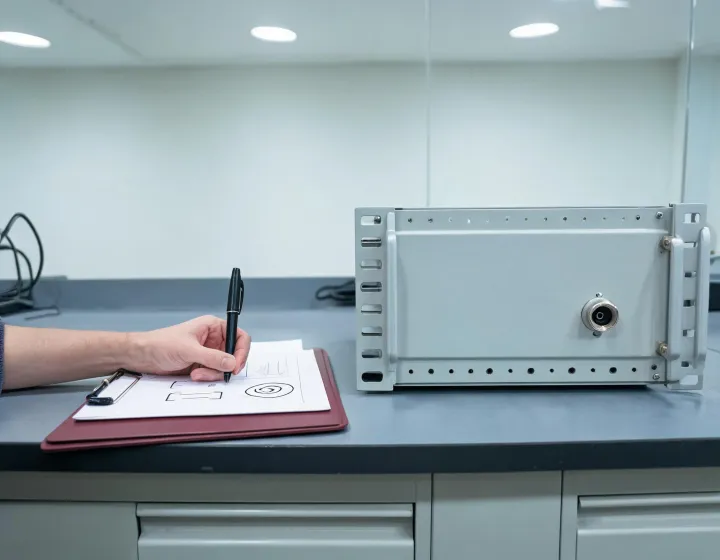
A black module in a brochure is not a specification. Ask each respondent to tie the next rows to one model and one datasheet date, for example 2025-04-18, so a later revision cannot slide into the comparison. The locked selection record for this desk lists a US volume of 100 for the phrase rf amplifier supplier, keyword difficulty 0, and a blank observation date. Treat that row as a selection record from the 2026-10-27 batch, not an order forecast.
| Check | What to write | What this desk will not infer |
|---|---|---|
| Frequency range | Start and stop in MHz, plus whether the span is one channel or a wider sweep. | A family name such as VHF does not set the edges. |
| Gain and transmit power | Small-signal gain in dB and the power rating at a stated compression point, such as P1dB or saturated output. | A headline watt number is not P1dB unless the sheet says so. |
| VSWR and return loss | The limit and the band where it applies. Reflection coefficient is (VSWR-1)/(VSWR+1). At 1.5:1 that is 0.20, so reflected power is 0.04 of forward power. | A photo of a connector is not a VSWR plot. |
| Impedance and connector | 50 ohm or another stated value, connector series, gender, and whether a mating cycle limit is published. | SMA and N are not interchangeable because both can appear on RF drawings. |
| Mounting and environment | Rack unit height if the chassis is 19 in, or a pallet that needs a heatsink. One rack unit is 1.75 in (44.45 mm). Ask for the ingress protection code when the cabinet is outdoors. | An indoor lab module does not inherit an outdoor rating. |
Background: in March 2026 a land-mobile buyer in Ohio sent one line that read radio amplifier, 40 units, warehouse delivery. Process: the desk split frequency range 136-174 MHz, 50 ohm, N female, 100 W continuous, and moved a 2 kW FM pallet that a respondent had attached onto a separate line. Result: the 100 W sheets could be compared on connector and duty, and the pallet left that comparison because cooling and peak-envelope wording did not match. The example is a procurement situation, not a published customer award.
Two buying disputes stay open on the sheet. New equipment may offer a clearer support path and a current datasheet date. Refurbished equipment may cover a legacy band when condition, remaining connector mating cycles, and warranty months are written down. An original-maker pallet may align with the radio vendor support policy. A compatible driver may widen the supplier list when the exact host, gain, and harmonic limit are verified on that model. The desk records both sides. It does not score them.
Title 47 CFR Part 2 Subpart J, reviewed on 2026-10-27 at the eCFR equipment-authorization page, supplies a question about whether an authorization file exists for the named model. It does not certify the amplifier this desk has not seen. ISO 9001, if offered, is a quality-system file for the factory, not a VSWR result. An NRTL safety file, if the supply voltage requires one, must name the same model.
Limits the desk will state up front: it does not assign a VSWR to an unnamed module, it does not convert a 50 ohm brief into a 75 ohm television plant, and it does not treat cooling airflow as included when the quotation is a bare pallet. Read the procurement brief, then open the inquiry lines.
Write the drive level in dBm and the modulation. A 0 dBm CW tone and a +10 dBm FM exciter ask for different gain. Channel width belongs on this layer when the radio is narrow, not on the heatsink.
This is the purchase line. Gain, power rating, impedance, VSWR, and connector live here. Insertion loss belongs on a following pad or filter, not inside the amplifier watt claim.
Polarization and radiation pattern are antenna questions. Leave them marked not applicable on a connectorized amplifier that has no radiator. A feeder with its own return loss is a separate line.
If the buyer states 2000 W RF and a drain efficiency of 0.50, the DC input is about 4000 W. At 48 V that is about 83 A before cable drop. Those figures are planning arithmetic from the buyer numbers, not a catalog current.
Pick one: saturated output, P1dB, or a pulsed peak with a stated duty. Ask for the measurement accuracy of the power meter and the calibration traceability date on the certificate, for example a calibration due before 2026-12-31. A watt sticker without that basis cannot be lined up.
Heat sink, fan, DC supply, harmonic filter, rack rails, freight, and commissioning are common exclusions. A lower module price that omits a 48 V supply is not the same delivered scope as a rack chassis that includes them.
Require the supplier to label compliant, deviation, or optional. A matching N connector does not establish gain flatness, harmonic level in dBc, or host compatibility with the exciter. The buyer accepts or rejects the deviation in writing.
Model, frequency range, gain, power basis, connector, and accessories.
Quantity, currency, per-amplifier or whole-order budget, destination, and freight.
Datasheet date, VSWR condition, test record, and any authorization file that names the model.
Send the brief from the contact page or open the form here. FREE sourcing support is available to qualified business buyers after the product, quantity, destination, and sourcing requirements are reviewed. Any added sourcing benefit is capped at up to 3% and is not a price cut printed on this page.
QUALIFIED BUSINESS BUYERS
Compare quotations after the amplifier configuration is written down.
Eligibility applies to qualified business buyers and is confirmed after we review your product, quantity, destination, and sourcing requirements.